Tampilkan postingan dengan label Fish. Tampilkan semua postingan

Priacanthidae

Animal Unique | Priacanthidae | Priacanthidae, the Bigeyes, family Includes 18 species of marine fish. "Catalufa" is the common name for the second year of some family members Priacanthidae. The origin of the scientific name ("prioo-" to bite + "akantha" thorns) Refers to the family very rough, spined scales. The common name of "bigeye" In the eyes refers to a species' unusually wide, which fit their lifestyles and carnivorous night. Typically Priacanthidae bright red color, mark Have some patterns in silver, dusky, brown or black. Most species reach a maximum total length of about 30 cm (12 in), although a few species A over pieces of 50 cm (20 in.) is known.

 
Most members of this family are native to tropical and subtropical share the Indian and Pacific Oceans, the purpose oven aussi species (japonicus Cookeolus, Heteropriacanthus cruentatus, Priacanthus arenatus and Pristigenys Alta) in the Atlantic. They are tend to live near rock outcroppings or reefs, deserted for A little known to open waters. Many species found in relatively deep water; achievable depths below normal scuba diving. Some species are fishing as fish food. The Earliest Fossil approbation Priacanthidae dates back to the middle Eocene epoch of the Tertiary période lower, around 40-50000000 gold years ago.

Animal Discovery And Animal Unique In The World

Sturgeon

Animal Unique | Sturgeon | The Sturgeon  or European, and Kaluga (Huso huso) is a species of anadromous fish in the sturgeon family (Acipenseridae) of Acipenseriformes order. It is found mainly in the basins of the Black Sea and Caspian, and sometimes in the Adriatic Sea. Very valuable fished for roe of the female known as Sturgeon caviar Sturgeon is a huge fish and a late maturing, which can live for numbers 118 species of years.The were significantly reduced by overfishing and poaching, which prompting many governments to adopt restrictions on trade. Most similar to Sturgeon Huso Huso huso is dauricus kaluga, also called the "Sturgeon River".
The common name of the sturgeon, Sturgeon whale as for the independent, is derived from the Russian word белый (Belyy), which means "white". The Sturgeon is a large predator that eats other fish. As do many sturgeons, the Sturgeon travels upstream in rivers to spawn. Sturgeon whales are much larger than giant catfish Mekong giant arapaima or.
The female Sturgeon is typically 20% larger than the male. Sturgeon caviar is considered a delicacy throughout the world. The flesh of the whale, on the other hand, is not particularly renowned. Sturgeon caviar has long been scarce and expensive. The endangered status of the fish was more expensive than caviar Sturgeon before.IUCN class as critically endangered.
It is a protected species listed in Annex III of the Bern Convention, and its trade is restricted under CITES Appendix II. The Mediterranean population is strongly protected under Annex II of the Bern Convention, the prohibition of intentional killing of these fish. The U.S. Fish and Wildlife Service has banned imports of Sturgeon caviar and other Sturgeon from the Caspian Sea since October 6, 2005, after the announcement sturgeon under the Endangered Species Act of the United States.
 
Animal Discovery And Animal Unique In The World
Detail: Sturgeon

Longhorn Cowfish

Animal Unique | Longhorn Cowfish | Longhorn Cowfish, Lactoria cornuta, is a lot of Ostraciidae boxfish family, recognizable by its long horns that protrude from the front of the head, and as a cow or bull. They are located in the Indo-Pacific Ocean and can grow up to 20 cm in length. Although poorly suited to an aquarium at home, Cowfish is becoming increasingly popular as a pet.
Adults are reef fish, often solitary and territorial, living around the sand or debris on the bottom to a depth of 50 meters. They are omnivorous, feeding on benthic algae, and foraminifera of various microorganisms that strains from the sediments, sponges, polychaete worms from sand flats, molluscs, crustaceans and small fish, small, able to feed on benthic invertebrates by blowing a stream of water at the sandy bottom.
 
There is no known sexual dimorphism, so both men and women display yellow to olive base color, which is decorated with white spots or bluish. Paired courtship just before or after sunset. Eggs and larvae are pelagic.
 
One difference from the other fish is the lack of gill cover, which is replaced by a small gap or otwór.Sześciokątne plate as the fish scales are linked together in a solid, triangular, box-like carapace, from which the fins and tail protrude. Their unique way of swimming pool ostraciform called, makes it look as if they floated. They have no pelvic skeleton, so they lack pelvic fins. Are slow swimmers Cowfish easily caught by hand, grunting noise when captured. This is the most familiar species Cowfish aquarium trade.
 
If you are seriously stressed, this species may be able to secrete a deadly toxin, ostracitoxin and ichthyotoxic, hemolytic, heat-stable and not dialyzable, no toxic proteins in the mucous secretions of the skin. This is apparently unique among known fish poisons, are toxic to boxfish and resembles red tide and sea cucumber toxins in general properties.

Animal Discovery And Animal Unique In The World
Animal Unique

Roosterfish


Animal Unique | Roosterfish | Roosterfish is a beautiful light-tackle gamefish and a member of the Carangidae family of jacks, so called after the crest of long dorsal spines that extends far above the body of the fish. It is used locally for its excellent quality food fish and marketed fresh. Roosterfish is a game fish in the marine waters around Guatemala, Mexico, Nicaragua, Costa Rica and Panama, and in the eastern Pacific from Baja California to Peru. Roosterfish inhabit shallow coastal waters, such as sandy shores along the beaches. They are often found around rock outcroppings and rocky islands. Young fish are often found in tidal pools. 


Scientific classification
Kingdom:     Animalia
Phylum:     Chordata
Class:     Actinopterygii
Order:     Perciformes
Family:     Nematistiidae
Genus:     Nematistius
Species:     N. pectoralis

A striking, iridescent fish, Roosterfish is characterized by seven long, filamentous dorsal spines, which are found even in young fish. This comb is upright when the roosterfish excited, as when threatened, but usually, the fin remains bags in a sheath on the back. There are also two curved dark stripes on the body, and a dark spot on the basis of the pectoral fin. It is the only fish in the genus and family Nematistius Nematistiidae. It is distinguished by its "rooster comb", seven very long spines of the dorsal fin. 


Roosterfish consume various small fish (50 pounds or more) being capable of capturing even bonito up to 2 pounds in size. When found along the beaches, they may compete in the schools and educate, with different members of a school while behind bait or lures, for large distances. Roosterfish can reach over 4 meters in length and over a hundred pounds. The weight of the fish connected to mean approximately 20 kg. The fish is popular as a game fish, but like most fish in the jack family, it is not considered a good eating fish.

Animal Discovery And Animal Unique In The World
Animal Unique

Striped Marlin


Animal Unique | Striped Marlin | Widely distributed in the Pacific, Striped Marlin is the most common marlin in Istiophoridae family of a prized catch fish. It is known for his martial arts and has a reputation of spending more time in the air than in water connected, not the overall size and weight of the blue marlin or black marlin, it's more acrobatically inclined. Besides making long runs and tail-walking, the "greyhound" on the surface, performing a dozen or more long, graceful leaps. It is caught fairly close to the coast in the right waters.


Scientific classification
Kingdom:     Animalia
Phylum:     Chordata
Class:     Actinopterygii
Order:     Perciformes
Family:     Istiophoridae
Genus:     Tetrapturus
Species:     T. audax

The most distinctive feature of Striped Marlin is the high, the first pointed dorsal fin, which is normally equal to or greater than the greatest depth body. Even in the most instances this fin at least 90 percent depth of the body. Like the dorsal, anal and pectoral fins pointed. They are also plane and displaceable, and can easily be folded flat against the sides, even after death. The sides highly compressed. The lateral line is straight, single and highly visible. The back is steel-blue fading to bluish silver on the upper flanks and white below the lateral line. There are a number of iridescent blue spots on the fins and light blue or lavender vertical stripes on the sides. These may not be prominent, but they are usually more prominent than those of other marlin, and they continue to exist after death, which is not always true in other Marlins.


One of the most interesting things about the Striped Marlinn is that it can actually change color. When a Striped Marlin excited, usually during feeding or the court, the bars on the regular blue to a phosphorescent blue or lavender. After a Striped Marlin dies, develops conspicuous stripes along the side of his body. But, the life of this species is poorly known. Striped Marlin are found in the warm blue waters of offshore environment, usually above the thermocline. They are usually solitary but may form schools according to size during spawning. They are usually present where there is plenty of forage.


The Striped Marlin is highly predatory, feeding extensively on sardines, anchovies, mackerel, Sauries, flying fish, squid, and what is there in abundance. The spear of the marlin is sometimes used as a tool for defense and capturing food. If it uses its bill in capturing food, the striped marlin sometimes stuns its prey by slashing sideways with the spear, instead of impaling his victim, as some believe. It is well known for his martial arts and has the reputation of spending more time in the air than in water after being hooked. Although it is not in danger, most researchers consider the Striped Marlin as "overfished." You can not farm marlin, so their numbers are not sustainable at the rate they are removed from the ocean.


Commercially fished for sushi and sashimi, Striped Marlins are also popular with anglers. Striped Marlins are notorious for their acrobatics when caught on a line. They can fight for an hour or more, jumping from the water and air. However, most of the fishermen of today let the marlin back to the ocean after a catch. The most common way to catch marlin by trolling with heavy gear. When struggling with a fish as big as a marlin, it's wise to include a harness, which gives you extra leverage and power.


The Striped Marlin has red meat and is the subject of extensive commercial fishing effort, especially by longlining. Many people throughout the Indo-Pacific range to hold his flesh in high regard, and it is best considered billfish for sashimi and sushi preparations. Heavy fishing pressure has led to reduced inventories, however, as is true for all billfish. Many anglers today to participate in a "tag and release" program in conjunction with marine life specialists and conservationists.

Animal Discovery And Animal Unique In The World
Animal Unique

Mahi Mahi


Animal Unique | Mahi Mahi | Mahi Mahi is also known as dorado or dolphin fish grow rapidly. They are among the finest of all fish. The Mahi Mahi is a pelagic fish found in off-shore temperate, tropical and subtropical waters throughout the world. It is one of only two members of the coryphaenidae family, the other being the Pompano dolphinfish. This fish is one of the top offshore gamefish among the fishermen and is an excellent, hard fighting species that puts on an acrobatic show once sold. Mahi Mahi has slim and streamlined body, tapered sharply from head to tail. Large male, called bulls, have high, vertical foreheads, while the female's forehead is rounded. The anal fin is 25-31 soft radiation and is long, which extends over half the length of the body. The dorsal fin has 55 to 66 soft rays. The tail fin is very forked, there are no protrusions in one of the fins and the mouth has bands of fine teeth.


Scientific classification
Kingdom:     Animalia
Phylum:     Chordata
Class:     Actinopterygii
Order:     Perciformes
Family:     Coryphaenidae
Genus:     Coryphaena
Species:     C. hippurus

Coloring of Mahi Mahi is variable and defies an accurate, simple description. Generally, when the fish lives in water, the Mahi Mahi is rich iridescent blue or blue-green dorsally, gold, blue and gold or silver gold on the lower flanks, and silvery white or yellow on the belly. The sides are sprinkled with a mixture of dark and light spots, ranging from black or blue to golden. The dorsal fin is rich blue, and the anal fin is gold or silver. The other fins are generally golden yellow, edged with blue. Dark vertical bands sometimes appear when the fish attacked prey. The color description of the Mahi Mahi is difficult because it undergoes sudden changes in color that occur in an instant, often when the fish is excited.


If the fish out of water, but colors range from blue, green and yellow, the colors that were clear when in the water quickly fade. After the death of the fish is usually a uniform yellow or silver. Mahi Mahi are among the fastest growing fish. They spawn in the warm ocean currents in a large part of the year, and their young are often found in seaweed. Mahi Mahi grow fast and of short duration. Few Mahi Mahi live longer than 4 years, and most live only 3 years. Males larger than females and are able to grow to 60 pounds in just 2 years, but this is exceptional and the result of consistently favorable warm water temperatures and abundant food. 


Mahi Mahi are extremely fast swimmers and feed in pairs, small packages, and schools, widely consume some food fish are most abundant. Flying Fish and squid are prominent food in areas where they exist, and small fish and crustaceans that are about floating Sargassum weed are usually part of the diet, especially for smaller dolphin. Mahi Mahi are very aggressive feeders, and they can move very quickly to capture a meal.


The Mahi Mahi is a prolific spawner and grows rapidly, which means that it must by nature an eating machine. Spawning begins in the first place in the spring or early summer and lasts several months in warmer waters. Mahi Mahi sexual maturity in their first year of life and produce a large quantity of eggs. Mahi Mahi schools and are often gathered in large numbers, sometimes by the thousands. They are almost always between the surface and 100 m depth, but they are found by fishermen on or just below the surface and are probably the most surface-oriented of all big-game fishing. This, plus the fact that they are visually oriented feeders mainly forage in the daylight, helps them to loved anglers. Offshore anglers encounter packs of dolphins and are able to entice strikes from different fish in quick order.


Mahi Mahi are highly sought after for sport fishing and commercial purposes. Sport fishermen try them due to their beauty, size, food quality and healthy population. Mahi-mahi is popular in many restaurants. Mahi Mahi can be caught a number of ways. The simplest and most common is the troll around sea bass pots or lobster pots. Weed lines and floating wood and other materials, excellent places to look. Mahi Mahi sometimes orient to objects as small as a cup of coffee.


The United States and the Caribbean countries are the main consumers of these fish, but many European countries to increase their consumption per year. Mahi Mahi is a popular food fish in Australia, mostly caught and sold as a byproduct of commercial tuna and swordfish fishery operators. Japan and Hawaii are major consumers. The Arabian Sea, particularly off the coast of Oman, has also Mahi Mahi. Initially, mahi-mahi were mostly catch (bycatch) in the tuna and swordfish longline fisheries. Now they are sought by commercial fishermen on their own merits.

Animal Discovery And Animal Unique In The World
Animal Unique
Detail: Mahi Mahi

Gafftopsail Catfish


Animal Unique | Gafftopsail Catfish | Gafftopsail catfish prefer deeper channels, particularly brackish water in the bays and estuaries with sandy soils of high organic content. The Gafftopsail catfishis found in the waters of the western central Atlantic Ocean and the Gulf of Mexico and Caribbean Sea. This is a common sea catfish fishing by both commercial fishermen and recreational anglers in the Gulf Coast, especially between April and August. His dark, tender, lean meat is a popular table fare and has a moderate flavor. Gafftopsail catfish has long poisonous spines that can cause painful wounds.


Scientific classification
Kingdom:     Animalia
Phylum:     Chordata
Class:     Actinopterygii
Order:     Siluriformes
Family:     Ariidae
Genus:     Bagre
Species:     B. marinus

Gafftopsail catfish has a steel-blue dorsal fins silvery belly, and a robust body with a broad depressed head, with a pair of flat barbs. The dorsal and pectoral fins are greatly elongated spines. The appearance is typical of a catfish with the exception of the deeply forked tail and poisonous, serrated spines. It also has a small bump that looks a bit like a wave. The typical length of an adult gafftopsail catfish is about 17 inches.


Gafftopsail catfish move in large schools and migrate from shallow bays and estuaries to open waters of the Gulf of Mexico in winter. This movement and migration in the Gulf coastal and estuarine waters are related to spawning activity and the environment conditions.Spawning takes place in the inshore waters of swallowing between April and July and has some special features. Gafftopsail catfish sexually mature at the age of 2 and are between 10 and 11 centimeters in length at the moment. They have a low fertility, producing only 20 to 64 eggs per female, their eggs are considered the largest of all eggs laid by fish bone. Males carrying the eggs and young in the mouth from 11 to 13 weeks until they are about 3 cm long, 55 or young are said to be carried out in this way at a time.


Crabs, shrimp, and various small fish to their diet, but like all catfish, Gafftopsail catfish have broad interests diet. In addition to humans, predators of the Gafftopsail catfish are the tiger shark and bull shark. Gafftopsail catfish are good eat, you can fillet and cut the red sidelines of each fillet to prevent "Muddy taste". When you are removing of the hook of this catfish, be careful with the poisonous spines on the pectoral fins and dorsal fin.


Gafftopsail catfish is a common catch in the southeastern United States, although it is also caught as far north as New York. They come from piers, jetties, reefs, and the surf, but also bottom fishing or flats fishing. They are attracted by the sound of struggling fish, like a popping cork creates. Catfish catch is also used to catch Gafftopsail catfish; catch is regulated in some states. Catfish traps include "slat traps," long wooden traps with an angled entrance, and wire hoop traps.

Animal Discovery And Animal Unique In The World
Animal Unique

American Goosefish


Animal Unique | American Goosefish | The American goosefish is described as largely a mouth with attached tail. A member of the family Lophiidae of deep-sea angler fish, the ugly, bottom-dwelling species of temperate waters is not a targeted gamefish, but occasionally caught by fishermen deep water below. More than two dozen species of angler fish exist worldwide, with American goosefish among them the biggest fish. American goosefish is also called Goosefish, American anglerfish, All-mouth or Fishing frog. It is native to the eastern coast of North America. It is found on sandy soils, gravel, shell fragments, mud and clay.sand soils, gravel, shell fragments, mud and clay.


Scientific classification
Kingdom:     Animalia
Phylum:     Chordata
Class:     Actinopterygii
Order:     Lophiiformes
Family:     Lophiidae
Genus:     Lophius
Species:     L. americanus

The American goosefish is dark brown, mottled with dark spots and blemishes. It has almost armlike pectoral is about halfway between its strongly flattened body. Small gill openings are behind them. The head is very large for its body size, and the mouth is cavernous, filled with sharp, curved teeth, and opening up. At the tip of the first spine is a flap of flesh that serves as a decoy to attract small fish within reach of the mouth graspingn. When the prey comes close enough, the American goosefish opens his big mouth and sucks his victim inside.


American goosefish have seen chocolate brown above, varied and finely mottled with pale and dark. The dorsal fins, the upper sides of the pectoral fins and tail are of a darker shade of same color as the back, except for nearly black at the ends, while the entire bottom of the fish is white or dirty white. Sometimes it is said, the top is dotted with white spots, but we have not seen any marked that way. Tiny described as mottled and speckled with green and brown.


The growth rate of American goosefish is fairly rapid and similar for both sexes until about four years, when about 19 cm long. After this, the women a little faster and seem to live longer, about 12 years, growing to just over 39 inches. Their maximum weight is 50 kilos, and the all-tackle world record is 49 pounds, 12 ounces. Sexual maturity occurs between the ages of 3 and 4. Spawning occurs from spring to early autumn, depending on latitude. Females lay a nonadhesive, mucoid floating egg raft or veil, which can be large as 39 meters long and 5 meters wide.


The American goosefish is an ambush predator. Most of his time on the sea floor partially covered with sediment waiting for suitable prey to pass. It can slow or "walk" swim with the help of his pectoral fins. The diet normally consists of fin and ray fish, squid, octopus and occasionally carrion. The meat of the monkfish is mainly located in the body, less in the "shoulders" and cheeks. The flesh is very white and moist, and was fairly firm when cooked. It is served in both soups and grilled, and is similar in texture to the meat of crustaceans. Boneless fillets are thick and like crab or lobster tail. Experts believe that the liver is also excellent. The fish is covered with a smooth, scaleless, elastic skin, where another thin membrane covering edible flesh.

Animal Discovery And Animal Unique In The World
Animal Unique

Atlantic Wolffish


Animal Unique | Atlantic Wolffish | Eel-like in body shape, the Atlantic wolffish are blenny family members to live in the cold Arctic waters of the Atlantic and Pacific. They are members of the family Anarhichadidae that includes seven species. The Atlantic wolffish also known as the Seawolf, Atlantic catfish, ocean catfish, eel wolf (the generic name of the Pacific relative), or sea cat, is a marine fish, the largest of the catfish family Anarhichadidae. Although it looks frightening, the Atlantic wolffish is only a threat to humans in defending itself from the water. The Atlantic wolffish inhabit both the west and east coasts of the Atlantic Ocean.


Scientific classification
Kingdom:     Animalia
Phylum:     Chordata
Class:     Actinopterygii
Order:     Perciformes
Family:     Anarhichadidae
Genus:     Anarhichas
Species:     A. lupus

Atlantic wolffish has long, subcylindrical in front, compressed in the caudal portion, smooth and slippery, the rudimentary scales embedded and almost hidden in the skin. Atlantic wolffish vary in color, usually seen as a purplish-brown, a dull olive green or bluish gray. The catfish lacks pelvic fins, and the dorsal fin, which begins just behind the head, extends to the caudal fin, but is not linked. The anal fin extends about half the length of the ventral surface. Atlantic wolffish have powerful jaws and a large number of wide-tooth used to the shells of mollusks and crustaceans crush. They also have sharp canines.


The Atlantic wolffish are primarily stationary fish, rarely moving from their rocky home. They are benthic dwellers, living on the ocean floor hard, often seen in corners and small caves. The sides of the gray-brown to purple body crossed by as many as a dozen vertical black bars. It is sedentary and rather lonely and is often found at depths of 45 to 65 fathoms. Populations are usually localized. Although the seems slow, it's bitter, it can quickly move short distances, and gives serious bites. Individuals can reach a length of 5 meters and weighs 40 pounds. They hunt for mollusks, crabs, lobsters and sea urchins. They do not eat other fish. 


The Atlantic wolffish is rarely caught by anglers and is usually taken by commercial otter. It has been overexploited and depleted in the western Atlantic Ocean. In the North Atlantic, similar sequences are spotted wolffish (A. minor) and the Northern wolffish (A. denticulatis). In the North Pacific, the very similar Bering wolffish (A. orientalis) comes from the Aleutian Islands in Alaska south to central California. The wolf-eel (Anarrichthys ocellatus) has a similar range, but reaches a length of 61 / 2 feet. These species are also caught by trawlers ommercial.


The way of the Atlantic wolffish fertilize their eggs distinguishes them from many fish. Instead of the female depositing her eggs in the open ocean and for males to fertilize and then continued on his way, they are internally fertilized and the male catfish remain in the nest and protects the eggs as long as four months, until the breeding is strong enough to gain independence. Their eggs are 5.5 to 6 mm in diameter (one of the largest known fish eggs), yellow-tinted and opaque. The eggs are laid on the ocean floor, many times in shallow water, stick together in loose groups, surrounded by rocks and seaweed. Atlantic wolffish mature relatively late, at the age of six.


In the north they are valued as food, both fresh and preserved. They are sold in Britain as "Scotch Halibut" and "Scarborough Woof" or simply "Woof" in other areas of the north-east coast, and are a popular ingredient in fish and chips. The oil extracted from the liver is said to be equal in quality to the best liver. According to scientific data, the Atlantic wolffish populations drastically declined due to overfishing and bycatch. Bottom trawling vessels also disrupt the Atlantic wolffish the rocky underwater habitat when dragging large nets along the seabed, with heavy weights to the nets on the ocean floor. The nets are randomly what they catch and the heavy weights and nets are harmful to the benthic terrain and its inhabitants. The sport has also threatened the survival of the Atlantic wolffish.

Animal Discovery And Animal Unique In The World
Animal Unique

Ballon Fish


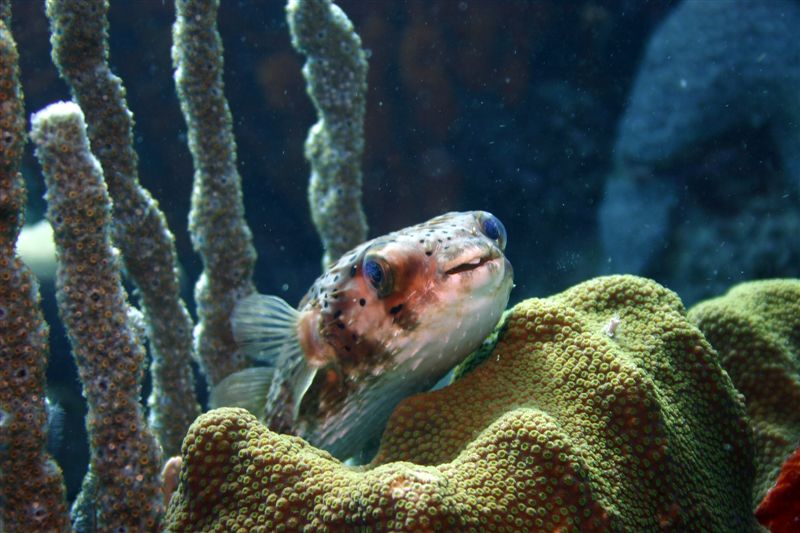
Animal Unique | Ballonn Fish | Balloon fish are known for their large eyes, spines and their ability to swell like a balloon when attacked. Adult balloon fishes occur on shallow reefs and the mangroves in the open land areas, including seagrass beds and rocky substrates. Swimming closely to the ground, they are found at depths ranging from two-100m below the surface of the water. The Balloon fish is circumtropically fish anywhere in the world oceans, including the western Atlantic from Florida and the Bahamas, south of Brazil. It is also present in the eastern Atlantic Ocean and the western central and eastern Pacific. 


Scientific classification
Kingdom:     Animalia
Phylum:     Chordata
Subphylum:     Vertebrata
Class:     Actinopterygii
Subclass:     Neopterygii
Infraclass:     Teleostei
Order:     Tetraodontiformes
Family:     Tetraodontidae

The body is covered with long, sharp spines that stabbing out when the fish is inflated. The inflated Balloon fish through water in the body when it is threatened. All members of the family Diodontidae capable of inflation. Along with inflation, may also change color due to the excitement. The Balloon fish is distinguished from similar species by the large dark spots on the sides and back that the color pattern and the small black spots interspersed between them dominate. Unlike its relative, the Porcupine fish, these small spots do not extend to the fins. The Balloon fish has a brown bar above and below each eye. The anal, dorsal and  pectoral fins are mainly used for navigating through coral at low speed. 


When threatened or frightened, the Balloon fish to take fish in the water - allowing you to expand its overall body size. This inflated, its spines erect. The spines and the extensive size may prove intimidating to potential predators. Balloon fish predators are nocturnal, usually hiding in crevices during the day. The teeth are fused into one entity, creating a strong, beak-like mouth is capable of cracking the shells of snails, sea urchins, and hermit crabs. During certain Pacific island communities, the balloon fish historically shaped like a helmet. 


The Balloon fish has a pelagic fish, or open-ocean, life. Spawning occurs after males slowly push women to the water surface. The eggs are spherical and exuberant, floating in the water. Hatch after roughly four days. The larvae are mostly yellow with scattered red spots. They are well developed with a functional mouth, eyes, and a swim bladder. Larvae less than ten days old are covered with a thin skin. After the first ten days, the shell is lost and the spines begin to develop. The larvae undergo a metamorphosis approximately three weeks after hatching. During this time, all fins and fin rays are present and the teeth are formed. The red and yellow color of the larvae do not persist into the juvenile phase and are replaced by olive and brown, typical adult. 


Dark spots will also appear at the bottom of the juvenile's. Pelagic young are often associated with floating sargassum, and these areas can serve as camouflage for predators such as dolphins, which swim among seaweeds. Young people to keep watching until they move along the coast and adults. The young Balloon fish does not undergo another metamorphosis to an adult. All changes now are external and include extension of the spines and normal body growth. Young Balloon fish consumed by many pelagic predators, including tuna and dolphins. Adults fall prey to sharks. They are shy creatures and will retreat if approached by a diver. In some parts of the world, are the dried, inflated bodies sold as tourist novelties. It is also used in Asian medicinal practices. The balloon fish caught in nets and sold to the aquarium trade.

Animal Discovery And Animal Unique In The World
Animal Unique
Older Post ►
 

Copyright 2011 Animal Unique In The World is proudly powered by blogger.com