Tampilkan postingan dengan label Shark. Tampilkan semua postingan

Sand Tiger Shark


Animal Unique | Sand Tiger Shark | Sand tiger shark is the most commonly reported along the Atlantic beaches. The Sand tiger shark, Gray nurse shark, Spotted ragged tooth shark, or Slue-nurse sand tiger is a species that inhabits coastal waters worldwide. It lives near the shores and beaches of North America, hence the name Sand tiger shark. It also lives in the waters of Japan, Australia and South Africa. Usually accidentally caught by fishing other fish wheels surf, sand tigers are slow and offer little resistance when hooked. In the western Atlantic Ocean, resulting from the Gulf of Maine to Argentina.


Scientific classification
Kingdom:     Animalia
Phylum:     Chordata
Class:     Chondrichthyes
Subclass:     Elasmobranchii
Order:     Lamniformes
Family:     Odontaspididae
Genus:     Carcharias
Species:     C. taurus

These sharks have a cat-like eyes and a mouth full of wicked-looking teeth. They are light gray in color, white on their belly, and the youth have some spots on their sides, which gradually disappear as they mature. They have a pointed, slightly upturned snout and rows of teeth that are fully shed over a period of 2 weeks. The fins are large and fleshy and provide hydrodynamic lift. The first dorsal fin is situated rather far back, and is close to the second dorsal fin, which is almost as big as the first. The tail is long and curved with a hook at the end. The Sand tiger shark can reach a length of more than ten meters. In one part of the world they are considered harmless, while in others they are considered very dangerous.


The Sand tiger shark is an active night feeder. It is the only known shark breath and save the shark's stomach, causing the shark to near neutral buoyancy, which helps to motionless and silent, so no hunting for its prey to keep alert. The sand tiger shark was seen in the hunting groups to gather with other sand tiger sharks when preying on large schools of fish. The sand tiger shark gathers in large numbers when hunting prey or during mating. The diet of the Sand tiger shark often consists of fish, young sharks, rays, crustaceans, and bluefin tuna caught in nets. However, the Sand tiger shark prefers bony fish such as eel, mullet, and sea bass.


Males reach sexual maturity at about six to seven years old and about 1.8 meters in length. Females reach maturity when about 2 feet long at about nine to ten years. During mating, the male grasps the female sand tiger fins with his teeth. This can leave deep cuts that usually heal within one week. The male shark claspers used to inseminate the female. The Sand tiger shark is one of the lowest reproduction rates of all types of sharks, so they are easily influenced by public pressure. Female sharks have two wombs. During early embryonic stages of the young absorb nutrients from a yolk sac and uterine fluids possibly consume. At about 10 inches long, the developing embryos in the wombs of mother slain and devoured by two puppies left, a process called intrauterine cannibalism. The surviving embryos continue to feed a constant supply of yolk capsules which contain 7-23 unfertilized eggs. After a long labor, the female gives birth to 1 meter long, completely independent offspring. The gestation period is about eight to nine months.


There are several factors that contribute to the decline in the population of the Sand tiger sharks. Sand tiger sharks are caught with trawl fishing, although they are often caught with a fishing line. Sand tigers' fins are a popular item in Japan market. Shark liver oil is a popular product in beauty products like lipstick. For example, overfishing is a major contribution to the population decline. In northern Australia, have taken nets to protect swimmers sharks. Many sand tigers are caught in the nets, and then strangled or fishermen. Estuaries along the United States of America the eastern Atlantic coast where most of the young Sand tiger sharks. These estuaries are subject to diffuse pollution that is harmful to the puppies.

Animal Discovery And Animal Unique In The World
Animal Unique

Sandbar Shark


Animal Unique | Sandbar Shark | The Sandbar shark is a kind of requiem shark, family Carcharhinidae. The Sandbar shark is also called Thick skin shark or Brown shark. It is one of the largest coastal sharks in the world, and is closely related to the Dusky shark, Bignose shark and ull shark. It is very common along the coast of the Mid-Atlantic states, sand banks to expand into the western Atlantic from southern Massachusetts to southern Brazil. In the eastern Pacific, which occur around the Hawaiian, Galapagos, and Revillagigedo Islands. The Sandbar shark, true to its nickname, is often found on muddy or sandy bottoms in shallow coastal waters such as bays, estuaries, harbors, or the mouths of the rivers, but also swim in deeper waters.


Scientific classification
Kingdom:     Animalia
Phylum:     Chordata
Class:     Chondrichthyes
Subclass:     Elasmobranchii
Order:     Carcharhiniformes
Genus:     Carcharhinus
Species:     C. plumbeus

Sandbar sharks are stout shark with a moderately long, rounded snout, and a high, triangular, saw tooth edges above. This species has a interdorsal cam and a strikingly large first dorsal fin. Sandbar sharks are blue-gray or brown to bronze in color on the back and flanks and white on the belly. The tips and outer margins of their fins are sometimes darker than the rest of their bodies. Sandbar sharks usually have heavy-set bodies and rounded snout that are shorter than the average shark's snout. Their upper teeth have broadly uneven cusps with sharp edges. The second dorsal and anal fins are near the same height. His body color can vary from a bluish to brownish gray with a bronze, with a white or pale underside. Sandbar sharks swim alone or in sex-segregated schools that vary in size.


Sandbar sharks are opportunistic feeders that prey on bottom bony fishes, small sharks, rays, cephalopods, gastropods, crabs and shrimp. Sandbar sharkss feed during the day, but more and more active at night. Natural enemies are the tiger sharks and great whites rarely. Sandbar shark and Dusky sharks are coastal migrants who have taken a particularly hard hit by longline fishing for both their meat and their fins. Sandbar sharks are generally called brown by fishermen along the East Coast of the United States, where they often migrate in large bays to spawn. Although in principle the ground sharks, they are extremely strong fighters. The twilight is almost indistinguishable from the Sandbar shark, but grows to more than 700 pounds, the sandbar never exceeded more than 200 pounds.


Sandbar sharks are viviparous. The embryos are supported in the yolk sac placenta in the mother. The female has a three year reproductive cycle and give birth to an average of 8 puppies. They carry the young for one year before birth. In the northern hemisphere, mating takes place in spring or early summer (May-June). Sandbar sharks in the Southern Hemisphere partner during the warmer summer months between late October to January. The mating begins when a man follows a woman, occasionally biting them between the dorsal fins until they give him access to a branch to insert into the cloaca. As with other shark species, women are often seen with permanent scars as a result of this mating ritual.


Sandbar sharks are considered harmless to humans. There are very few cases of sandbar sharks make unprovoked attacks on humans. You should always use caution to protect yourself against sharks and other marine creatures when swimming or wading. This species has slowly grown and has a low reproduction and is therefore particularly vulnerable to threats such as commercial hunting and the subsequent overfishing. The Chesapeake Bay is one of the most important Sandbar shark nursery areas on the east coast.

Animal Discovery And Animal Unique In The World
Animal Unique

Porbeagle Shark


Animal Unique | Porbeagle Shark | The Porbeagle shark is a member of the mackerel shark family, like the great white shark and the Mako, and bears a resemblance to both types. A widespread species, it exists in the western Atlantic Ocean from Newfoundland to New Jersey, although it rarely ventures south of New England and probably ranges from southern Brazil to Argentina. The Porbeagle shark is one of the most cold tolerant species of pelagic sharks in the world, prefer water temperatures below 18 C. The porbeagle is a counter flow heat exchanger in the bloodstream, which makes it possible to maintain a body temperature 7-10 degrees higher than the ambient temperature of the water.


Scientific classification
Kingdom:     Animalia
Phylum:     Chordata
Class:     Chondrichthyes
Subclass:     Elasmobranchii
Order:     Lamniformes
Family:     Lamnidae
Genus:     Lamna
Species:     L. nasus


The Porbeagle shark is a robust, cobalt blue body with a perfect conical snout, ending in a point. It is easily recognized by its teeth, which are smooth and have little bumps on both sides of the base. It often has a distinctive white area at the foot of the first dorsal fin is this more apparent than on the mako and white sharks. There is a huge, especially prominent, flattened keel on both sides of the tail, and below, but further back on the tail is a small secondary keel, which also lack Mako sharks and white. The anal fin is directly in line with the second dorsal fin.


Fast and energetic, the
Porbeagle shark are found singly or in groups. Porbeagle shark swallows its prey whole and feeds on a diverse group of fishes and invertebrates. They eat mackerel, herring and squid in winter, cod, flounder and other bottom fish in the fall as less common prey, such as wolf-like, spiny dogfish, small crabs and shellfish. Bits of fishing line, rope, shiny packaging and plastic packaging are all found in their stomach contents as well. 


Porbeagle sharks are potentially dangerous to humans because of their large size. But the Porbeagle shark is very seldom attacked swimmers or boats. None has ever accused porbeagle in unprovoked attacks on humans, probably because they live in such cold water, but as a member of the Mako and Great White sharks is one of the fastest swimmers in the sea. It belongs to the top of the food chain and is the top predator in its own territory.


The meat of Porbeagle shark is of good quality and texture and is said to taste like swordfish. Excellent sportfish, Porbeagle sharks occur in colder waters than Makos and whites, which may explain why they are not involved in attacks on humans. The Porbeagle shark is one of the fastest swimmers in the sea, but it can not swim out of the commercial fishermen on the North Atlantic come from around the world in search of her highly acclaimed flesh. The shark population is almost the lowest ever, but things are looking for this endangered species. But now, since the large cuts in fishing quotas for porbeagle shark in recent years, it is slowly recovering.

Animal Discovery And Animal Unique In The World
Animal Unique

Bonnethead Shark


Animal Unique | Bonnethead Shark | The Bonnethead shark is the smallest member of the hammerhead, the family is characterized by having the eyes situated at the ends of the extended lateral lobes. The Greek word Sphyrna translates as hammer, referring to the shape of the head of this shark's - tiburo is the Taino word for shark. The Bonnethead shark is very distinctive in appearance because it has a smooth, wide extended main, often described as "spade-shaped," with more curve to do it over the heads of other hammerhead sharks. Also, the front of the head lacks a median groove, which is present in other hammerheads. These fish are in the western Atlantic Ocean from North Carolina (occasionally Rhode Island) to the south of Brazil, but also around Cuba and the Bahamas, and in the eastern Pacific from southern California to ecuador.


Scientific classification
Kingdom:     Animalia
Phylum:     Chordata
Class:     Chondrichthyes
Subclass:     Elasmobranchii
Order:     Carcharhiniformes
Family:     Sphyrnidae
Genus:     Sphyrna
Species:     S. tiburo

Characterized by a broad, smooth, spade-like head, they have the smallest Hammerhead sharks of all Sphyrna. Gray-brown above and lighter on the bottom, it is a timid and harmless sharks. The Bonnethead shark is an active tropical shark that swims in small groups of 5 to 15 people. Strangely, though, the schools of hundreds or even thousands reported. Bonnethead sharks move constantly following changes in water temperature and respiration maintained. The Bonnethead shark will sink if it does not keep moving, because hammerhead sharks are among the most negative buoyancy of marine vertebrates.


Gray to gray-brown in color, the bonnet head shark is rarely higher than 3 meters in length, maturing at about this length to contribute 6 to 12 live young at a time. Bonnethead sharks, especially juveniles, often more than flats, where they can be taken on fly and ultra light tackle. It feeds mainly on crustaceans, mostly consisting of blue crabs, but also shrimp, mollusks and small fish. Seagrasses are found in the stomach contents. To accommodate the many species of animals that feed it, the bonnet head shark has small, sharp teeth on the front of the mouth (for grabbing soft prey) and flat, wide choice in the back (for crushing hard-shelled prey).


The reasons for Hammerhead sharks scientific debate has caused more than a decade. Whatever the ultimate goal, a wing-shaped leaves cephalofoil hammerhead sharks swimming in a horizontal plane and was thought to allow them to perform sharp turns. However, research shows that the vortices that help them perform sharp bends. The t Hammerhead sharksl is responsible for enhanced electroreception and increased olfactory acuity.


The pectoral fins of most fish control throw (up-and-down movement of the body), yaw (side-to-side motion) and rolling. Most Hammerhead sharks do not roll or yaw and pitch to achieve using their cephalofoil. The smaller of a Bonnethead shark is not as successful, and they therefore have to rely on the combination of their large pectoral fins and cephalofoil for most of their mobility. Compared with other Hammerhead sharks, Bonnethead shark have larger and more developed pectoral fins and are the only kind of hammer to actively use flippers for swimming.

Animal Discovery And Animal Unique In The World
Animal Unique

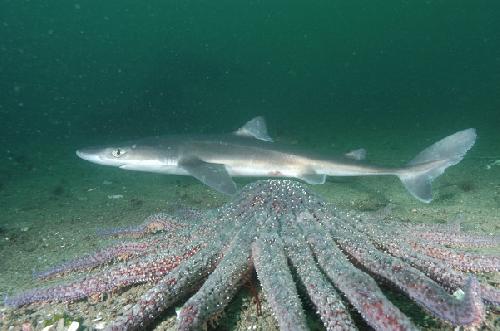
Spiny Dogfish


Animal Unique | Spiny Dogfish | The Spiny dogfish, dogfish, piked dogfish or mud shark, is one of the best known of the dogfish, which are members of the family are in the order Squaliformes. Although these common names apply to different species, Spiny dogfish is distinguished by having two spines (one anterior to each dorsal fin) and lacks an anal fin. It occurs mainly in shallow waters and further offshore in most parts of the world, especially in temperate waters. More is known about it than other types of sharks, it has been widely studied in scientific laboratories. It is extensively used by people as food, fertilizer, hide, pet food, oil and liver.


Scientific classification
Kingdom:     Animalia
Phylum:     Chordata
Class:     Chondrichthyes
Subclass:     Elasmobranchii
Order:     Squaliformes
Family:     Squalidae
Genus:     Squalus
Species:     S. acanthias

The Spiny dogfish has dorsal spines, no anal fin, and white spots along its back. The caudal fin has asymmetrical lobes, forming a heterocercal tail. The species name acanthias refers to two of the shark spines. These are used defensively. If caught, the shark can arch its back to pierce his Captor. Glands at the base of the spines secrete a mild poison. Both sexes are gray-brown in color and are counter shaded. Males are identified by a pair of pelvic fins modified as sperm-transfer organs, or "claspers". The man adds a rank in the female cloaca during copulation.


The smooth teeth of Spiny dogfish are located in rows which rotate into use as needed. The first two rows are used in obtaining prey, the other rows rotate into place when needed. If lost teeth, broken or worn, they are replaced by new teeth that rotate into place. The Spiny dogfish is an opportunistic feeder eat whatever prey is abundant. In general, their diet is small fish such as capelin, cod, haddock, hake, herring, menhaden and ratfish. They also eat invertebrates such as krill, crabs, polychaete worms, jellyfish, ctenophores, amphipods, squid and octopus.


This shark is present in all the world's temperate oceans It ranges in the coastal waters of the Atlantic and Pacific. The Spiny dogfish is a seasonal migrant into Canadian waters. In June these sharks appear off Nova Scotia in the Bay of Fundy and off southwestern Newfoundland. In July they move into the Gulf of St. Lawrence and in waters off southern Labrador and around the rest of Newfoundland. By late fall most of the dogfish migrate out of Canadian waters and to the south to the waters off North Carolina and New England. Spiny dogfish are not considered dangerous, but some damage can be done through their teeth and their slightly poisonous dorsal fin spines. Spiny dogfish are gregarious (social) and travels in schools of hundreds to thousands of individuals. These schools are often segregated by gender and age. They are called dogfish because they travel and hunt in packs. They migrate in schools, after cool water.


Spiny dogfish are caught for food in Europe, the United States, Canada, New Zealand and Chile. The meat is mainly in England, France, Benelux and Germany. The fins and tails are processed into fin needles and are used in less expensive versions of shark fin soup in Chinese cuisine. In England Spiny dogfish and other dogfish are sold in fish and chip shops as "rock salmon" or "Huss", in France it is sold as "small salmon" in Belgium and Germany and is sold as "sea eel". It is also used as fertilizer, liver oil and pet food, and because of the availability, cartilage skull, and the manageable size, such as a popular vertebrate dissection specimen, in both high schools and universities.

Animal Discovery And Animal Unique In The World
Animal Unique

Blue Shark

 
Animal Unique | Blue Shark | The Blue shark is a kind of requiem shark, family Carcharhinidae, which inhabits deep waters in temperate and tropical oceans of the world. Blue sharks are pelagic. It means they are found in open water. Like most pelagic sharks, they found the whole world. Blue sharks migrate east across the Atlantic each year, following the warm Gulf Stream waters. They travel a circuit of the Caribbean Sea, along the coast of the U.S., eastern Europe, south of the African coast and back to the Caribbean.

Scientific classification
Kingdom:     Animalia
Phylum:     Chordata
Class:     Chondrichthyes
Subclass:     Elasmobranchii
Order:     Carcharhiniformes
Family:     Carcharhinidae
Genus:     Prionace
Cantor, 1849
Species:     P. glauca


The Blue shark is one of the most easily recognized sharks. It has a unique color, a deep indigo blue top and a vibrant blue on the sides to white underneath. The large pectoral fins are also easy to spot as they are, as long as the distance between the tip of the snout to the last gill slit. The Blue shark is a long slender shark, reaching 3.8 meters (13 feet) in length. It is probably the most productive of the large shark species as it is abundant throughout the range. The Blue shark has a weak keel on the tail and the upper lobe of the caudal fin is larger than the bottom. The teeth on both upper and lower jaw have triangular cusps with smooth or finely toothed edges.

Squid is an important prey for Blue sharks, but their diet also other invertebrates such as squids and octopuses pelagic as well as lobster, shrimp, crab, many bony fishes, small sharks, mammalian carrion and occasional sea birds. Whale and porpoise blubber and meat are taken from the stomachs of fish caught and they are known for taking cod from trawl nets. Blue sharks seldom eat tuna. Young and small individuals can get eaten by a sufficiently large sharks, such as the Great White Shark and Tiger Shark.


Blue sharks are the most heavily fished sharks mainly as by catch. It is estimated that 10 to 20 million people are slain every year due to fishing. The flesh is edible, but not widely sought, it is consumed fresh, dried, smoked and salted and diverted for fish meal. The skin used for leather, fins for shark fin soup and liver oil. Blue sharks are occasionally sought as game fish for their beauty and speed.

Although Blue sharks are among the most common, widespread, fertility and rapid growth of the sharks, they are one of the most heavily fished sharks in the world. There is concern not only about what this does for Blue shark populations, but also about the effect of removing such an important predator might have on the oceanic ecosystem Blue sharks are one of the most important species in international trade shark. However, their flesh, and eaten in a few countries, is not very popular. They are also an important fish species in some areas.

Animal Discovery And Animal Unique In The World
Animal Unique
Detail: Blue Shark

Leopard Shark

Animal Unique | Leopard Shark | The Leopard shark is a type of hound shark, Triakidae family, they are currently an abundant species in cool and warm temperate waters. They are found in inshore and offshore continental coastal waters. The most common at or near the bottom in shallow waters. They prefer sandy or muddy bays. They are active, strong swimmers and are known for great schools that seem to be nomadic form. The swimming motion of this type is described as undulating. Leopard sharks are often seen together with smooth brown dogs, black dogs, smooth or angled dogfish. Leopard sharks are found in the eastern Pacific from Oregon to the Gulf of California, Mexico.

Scientific classification
Kingdom:     Animalia
Phylum:     Chordata
Class:     Chondrichthyes
Subclass:     Elasmobranchii
Order:     Carcharhiniformes
Family:     Triakidae
Genus:     Triakis
Species:     T. semifasciata

Leopard sharks have short, broad rounded snout, their first dorsal fins are moderately large, its origin is their pectoral inner margins. Their second dorsal fin is almost as big as the first one (height is about 3 / 4 of the first dorsal fin) and their external anal fins are much smaller than their second dorsal fin. Their pectoral fins are broad triangular and they have very conspicuous dark saddles and spots on their bodies. They have a gray to bronze-gray upper bodies with light belly (bottom) surfaces. Their average size is between 1.2 to 1.5 m and the maximum total length is about 1.8 m. Leopard sharks can be a weight of 18.4 kg and live for as long as 30 years.

Leopard sharks feed primarily on bottom dwelling invertebrates. Other small sharks are also found in their stomachs. Their diet seems to change with the seasons and age / size. An active species that swims with strong undulation, the lLeopard sharks spotted cruising in general, or just outside the surf zone. It is more active at night than during the day, and sometimes is still on the ground. From birth, leopard sharks, large schools are generally separated by age and sex, which can mix with a gray or brown smooth hounds and spiny dogfish.

Leopard sharks are viviparous aplacental (ovoviviparous) and they produce between 4-29 pups per litter. Their size at birth is about 20 cm outside and they grow slowly. They reach maturity at about the age of 10 years, men with a size between the timing 0.7-1.2 meters, females at about 1.1-1.3 m, respectively.
Ovoviviparous: eggs are retained in the body of the woman in a brood chamber where the embryo develops, receiving food from a yolk sac. This is the method of reproduction for the "live-bearing" fishes where pups hatch from egg capsules in the womb of the mother and shortly after birth.

Leopard sharks are harmless to humans. This medium sized shark is fairly common in the coastal bays and estuaries and are recognized by both commercial and recreational fishermen outside. Although a slow-growing, mature late shark with low productivity, management introduced in recent decades apparently protected the core of the population in California and Oregon waters from overfishing.

Animal Discovery And Animal Unique In The World
Animal Unique

Lemon Shark

Animal Unique | Lemon Shark | The Lemon shark is a shark in the family Carcharhinidae. It is known as the Lemon shark, because at some depth, light interaction with the local sea shark can give a tanned look pitted and yellow, like the size of a lemon. Lemon sharks are usually found in subtropical shallow waters near coral reefs, mangroves, closed bays, and the sounds and estuaries, while Lemon sharks do not seem to travel far into fresh water. They can be found in open water during migration, but in general they tend to stay along the continental and insular shelves. This species is known to groups based on size and sex and shape are seen in groups near fishing docks and piers at night to return to deeper water during the day.

Scientific classification
Kingdom:     Animalia
Phylum:     Chordata
Class:     Chondrichthyes
Subclass:     Elasmobranchii
Order:     Carcharhiniformes
Family:     Carcharhinidae
Genus:     Negaprion
Binomial name:     Negaprion brevirostris, (Poey, 1868)


Lemon sharks are named for their pale yellow to brown color on their dorsal (upper) side and a lighter yellow on their belly (lower) sides. The growth rate of the lemon shark is 0.54 cm per year. This species has two dorsal fins of similar size, the first is far back on the body behind the pectoral fins, second dorsal fin is located slightly forward of the origin of the anal fin. No interdorsal ridge. The ventral fin is slightly concave rear margins and the outer edge of the pectoral fin is slightly convex. Both the pelvic and pectoral fins are slightly curved. This shark has a blunt, short snout.

The Lemon shark is viviparous, meaning that women form a placenta-like connection to each of the developing fetus and eventually give birth to live free swimming puppies. Females and males reach sexual maturity at 6-7 years of age or at 2.4 m and 2.24 m respectively. Mating occurs in spring in shallow water, followed by a 10-12 month gestation period. Females return to shallow soils nurse from April to September to give birth to 4-17 pups measure between 60-65 cm external. Pups remain in the nursing grounds for several years, expanding their range as they grow.

Lemon sharks feed on bony fish, including: catfish, mullet, jacks, pill, porcupine fish, and Cowfish and guitar fish, stingrays, eagle rays, crabs and lobsters. Occasional lemon sharks also eat small sharks and seabirds. All the Sharks have electroreceptors concentrated in their heads, called the ampules of Lorenzini. These receptors detect electrical pulses emitted by potential prey. Lemon sharks are bottom dwellers. They have poor eyesight and can not see to find their food, but are equipped with highly sensitive and accurate magnetic sensors in the nose.

Lemon sharks are both commercial and recreational hunting. U.S. longline goal lemon sharks and they are also caught as bycatch in the gillnet and pelagic. Their fins are sold for shark fin soup, and their skin is sold for leather. Lemon sharks are also sold for their meat. Population in the western North Atlantic and eastern Pacific are due to decreasing over-fishing. Lemon sharks are potentially dangerous to humans, but the International Shark Attack File only reported 10 unprovoked bites lemon sharks, all of which happened in Florida and the Caribbean.

Animal Discovery And Animal Unique In The World
Animal Unique

Atlantic Sharpnose Shark

Animal Unique | Atlantic Sharpnose Shark | The Atlantic sharpnose shark is a requiem shark of the family Carcharhinidae. These sharks prefer subtropical waters near continental shelf outside of the intertidal zone to deeper waters. They are often found near the surf zone of sandy beaches and closed bays, sounds, harbors, estuaries and river mouths. This shark is able to tolerate low salinity, but they do not venture into freshwater bull sharks. Atlantic sharpnose sharks are found in the western Atlantic from New Brunswick, Canada south to the Gulf of Mexico and the Southwest Atlantic along the coast of Brazil in waters ranging from 10 to 280 m.

 
Scientific classification
Kingdom:     Animalia
Phylum:     Chordata
Class:     Chondrichthyes
Subclass:     Elasmobranchii
Order:     Carcharhiniformes
Family:     Carcharhinidae
Genus:     Rhizoprionodon
Species:     R. terraenovae

Atlantic sharpnose sharks are small, gray, streamlined shark, with characteristic long, pointed snout. The males reach at least 1 m long, females may be slightly higher to 1.1 m. Their average weight is 7.25 kg. The edge of the anal fins are straight or slightly concave. Their second dorsal fin located behind their anal fins. Atlantic Sharp Nose sharks are known to be at least 10 years of age to reach.

 
Sexual maturity is reached when an Atlantic sharpnose shark is about 83 cm. The young are fed into the female viviparous development. Litters of 4-7 pups are born in June in shallow water or estuaries. Newborns are 22-35 cm in length. Atlantic sharpnose sharks feed on small bony fishes, shrimps, crabs, worms and mollusks. This shark, like most, is harmless to humans. The Atlantic sharpnose shark is a common nuisance to fishermen as bait for other fish to take. It's a small shark and not considered dangerous to humans.

Animal Discovery And Animal Unique In The World
Animal Unique
Older Post ►
 

Copyright 2011 Animal Unique In The World is proudly powered by blogger.com